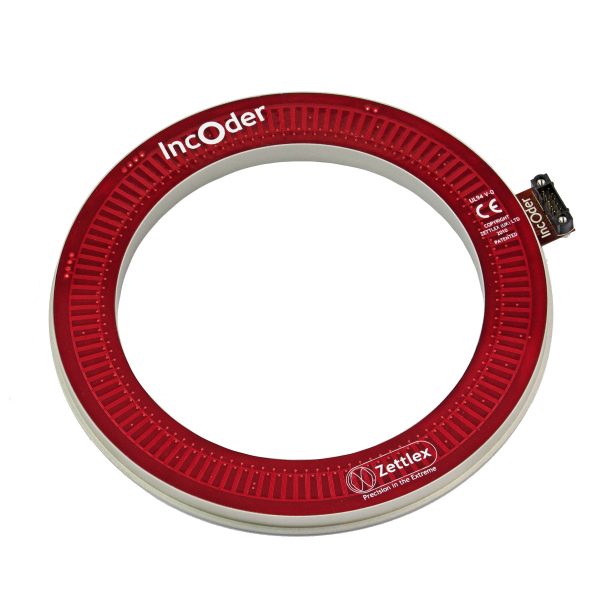
Part no.: Zettlex/Celera Motion Mini
• Compact size (37, 58mm options)
• Interfaces: SSI, SPI, BiSS-C, Incremental
• Up to 17 bit resolution
• Ultra high shock and vibration options
Zettlex IncOders are non-contact devices for precise angle measurement. They use an inductive technique, similar to that used by electrical transformers. IncOders are well suited to harsh environments-where potentiometers, optical or capacitive devices might be unreliable. IncOders have two main parts each shaped like a flat ring: a Stator and a Rotor. The Stator is powered and measures the angular position of the passive Rotor. A big bore and low axial height allows easy integration with through-shafts, slip-rings, direct drivemotors, optical-fibres, pipes or cables.
"*" indicates required fields
Zettlex/Celera Motion
Zettlex/Celera Motion IncOder Core
Zettlex/Celera Motion
Robonaut 2 (R2) is a state-of-the-art, highly dexterous anthropomorphic robot. The robot is designed to work with humans and has the ability to use the same workspace and tools.
The robot joints incorporate dual encoders for position and torque feedback while performing in a dynamic application, vibration, shocks, and wide temperature range.
Improved Encoder Accuracy Brings Hidden Benefits
Capacitive rotary encoders such as those from Netzer Precision are known for their low profile, high noise immunity and excellent accuracy. As a result, they are an excellent choice for applications such as camera systems, radar, slip-rings and robotic joints. Often times in these tasks the encoder is used for velocity feedback, ensuring a smooth […]
Osico Oil-Mon Oil Quality Sensor
Particle Contamination, Water Contamination and Oxidation. Any one of these nuisances can spell disaster for lube oil. Of course, you run a lab oil analysis program so you know periodically what these levels are in a machine. But what if you could monitor these parameters in real time? Osico Oil-Mon is a 4-in-1 oil quality […]
Accuracy, Resolution and Repeatability
There are several key terms that are critical to specifying the optimal position sensor for a given application. This application note defines these key terms and how they relate to the sensor’s role in the overall system performance. It is important to consider that precision is very much a system issue and can be dominated by mechanical errors such as eccentricity. This paper discusses the most significant mechanical error for rotary applications (eccentricity) and presents eccentricity tolerant position sensor solutions.