


Tilt sensors are essential for accurately measuring angular positions and maintaining stability in a wide variety of applications. Whether you’re optimizing heavy machinery, ensuring safety in construction equipment, or enhancing robotic systems, our high accuracy tilt sensor solutions deliver exceptional reliability and performance. At Everight Position, we offer advanced tilt sensor technologies designed to meet your specific needs and challenges.
Everight Position offers a comprehensive range of tilt sensors designed to meet the most challenging requirements. Our product line includes:

Engineered to withstand harsh environments and extreme conditions.

Tailored designs for industry-specific needs and unique challenges.
Every tilt sensor is built to integrate seamlessly with your system, ensuring consistent performance, dependable measurements, and minimal downtime.


Selecting the right tilt sensor is crucial for achieving precise angle measurements and maintaining operational efficiency. Consider these key factors when making your choice:
By carefully evaluating these factors, you can ensure that the tilt sensor you choose provides optimal performance and reliability for your unique application.
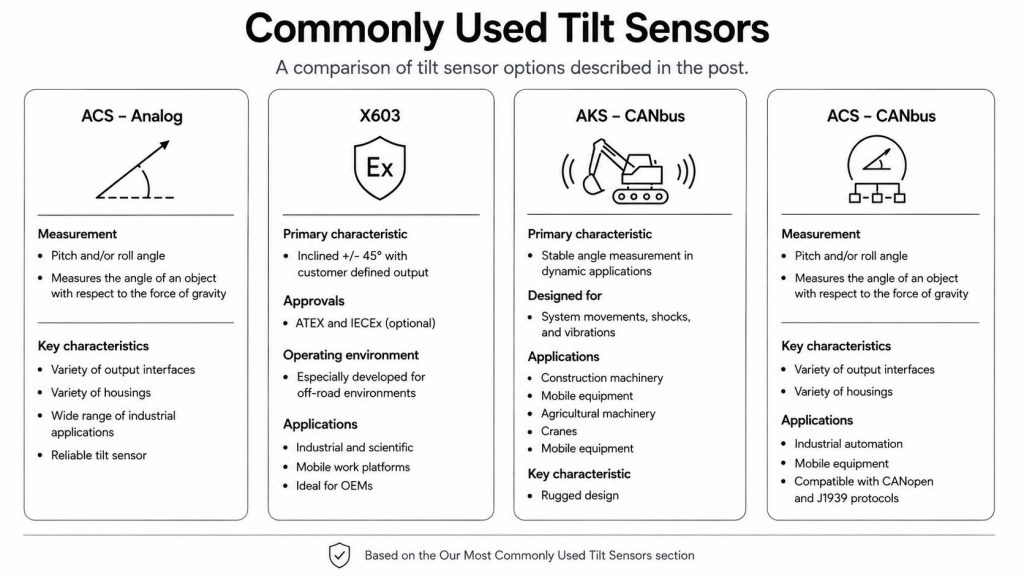
The intrinsically safe X603 tilt sensor is ATEX and IECEx approved for use in potentially explosive gas and vapour atmospheres. It is designed for industrial and scientific feedback applications and is ideal for OEMs seeking a high accuracy tilt sensor for demanding applications in hazardous areas.
The X603, like all Positek sensors, is supplied with the output calibrated to the angle required by the customer, between 15 and 160 degrees, and with full EMC protection built in. The tilt sensor provides a linear output characteristic with angle of deflection. There is a machined registration mark to identify the calibrated midpoint.
Overall performance, repeatability, and stability are outstanding over a wide temperature range. Electrical connections are made via an industrial-standard 4-pin M12 connector, with limited rotational capability to facilitate cable routing.
The sensor has a rugged stainless steel body and anodized aluminium mounting flange. The flange has two 4.5 mm by 30-degree-wide slots on a 48 mm pitch to simplify mounting and position adjustment. Environmental sealing is rated to IP67.
Positek intrinsically safe tilt sensors are designed to be used with a galvanically isolated amplifier. Approved galvanic isolation amplifiers (X005) are available from Positek, with a choice of 0.5–9.5V or 4–20mA transmission outputs.
The sensor can be installed with a cable length of up to 1 km between the sensor and the amplifier.
At Everight Position, we understand that every project is unique. Our team of experts is dedicated to helping you find the ideal solution and ensuring a smooth integration process. We provide:
Our tilt sensors and high accuracy tilt sensor solutions are trusted across a wide range of industries, including:
Looking for a reliable tilt sensor or a high accuracy tilt sensor for your next application? Everight Position offers durable, precision-engineered tilt sensors designed to perform in the toughest environments. Contact our team today to discuss your requirements, request expert advice, or find the ideal sensing solution for your project.
Static inclinometers measure orientation relative to gravity, while dynamic inclinometers are designed for applications involving movement, shocks, and vibration. POSITAL dynamic inclinometers combine a 3D accelerometer and 3D gyroscope to compensate for acceleration effects during motion.
Yes. Everight offers intrinsically safe tilt sensors for potentially explosive environments. For example, the X603 is intrinsically safe and ATEX and IECEx approved for potentially explosive gas and vapor atmospheres, while other Positek models are available for gas, vapor, dust, and mining environments.
Everight’s inclinometers are available with different electrical interfaces, including analog voltage and 4-20mA current, CANopen, J1939, MODBUS RTU, SSI, and RS232 options depending on the model. This allows the sensor output to be matched to the communication requirements of the application.
Yes. The specific range of each series is different but options exist for single axis inclinometers up to 360 degrees and +/90 degrees for dual axis, commonly desired in pitch/yaw applications.
Have questions or need help finding the right solution? Our team is ready to assist.
"*" indicates required fields