
Robotics and autonomous systems place demanding requirements on position sensing and rotary connectivity. Applications such as robotic joints, actuators, mobile platforms, gimbals, and autonomous equipment may require precise position feedback while operating within tight mechanical constraints or challenging environments.
Everight works with engineers to identify sensing technologies that balance accuracy, mechanical packaging, environmental durability, interface requirements, reliability, and cost. Solutions for robotics applications can include rotary encoders, linear position sensors, inclinometers, inductive position sensors, and slip rings.
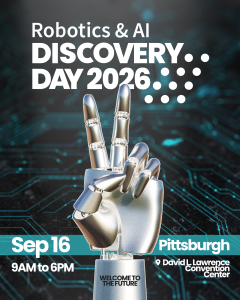
In September 2026, Everight exhibited at Pittsburgh Robotics & AI Discovery Day at the David L. Lawrence Convention Center, highlighting position sensing and rotary connectivity technologies for robotics and autonomous systems.
Position Sensing for the Next Generation of Robotics
As robotics moves beyond traditional factory automation and into autonomous vehicles, mobile machines, defense systems, inspection equipment, logistics, and other real-world applications, position sensing requirements are becoming increasingly demanding.
Everight works with engineers to identify sensing technologies that balance accuracy, mechanical packaging, environmental durability, interface requirements, reliability, and cost.
At Robotics & AI Discovery Day, Everight highlighted technologies including:
- Rotary encoders (link) for robotic joints, motors, actuators, gimbals, and rotating mechanisms
- Through-bore and low-profile encoders for space-constrained designs
- Inductive position sensing for harsh-environment and high-reliability applications
- Linear position sensors for actuators, cylinders, and other linear motion systems
- Inclinometers for tilt, platform orientation, and mobile robotics
- Slip rings (link) for transferring power, Ethernet, data, and other signals across continuously rotating interfaces
Rather than approaching every application with a single sensing technology, Everight can evaluate optical, magnetic, inductive, capacitive, and other approaches to determine the most appropriate solution for the application.
Joined by POSITAL and Novanta / Zettlex
Everight was joined by Christian Fell of POSITAL (www.posital.com) and Ryker Miles of Novanta / Zettlex (www.zettlex.com).
Their attendance gave engineers the opportunity to discuss applications directly with representatives from two of Everight’s key position-sensing technology partners, while also allowing us to compare different sensing approaches for challenging robotics and automation applications.
Part of Pittsburgh’s Robotics and Technology Community
Everight is a member of both the Pittsburgh Robotics Network and the Pittsburgh Technology Council (link), reflecting our continued involvement with the region’s growing robotics, automation, and advanced-technology community.
Pittsburgh has developed one of the country’s most concentrated robotics and AI ecosystems, with more than 120 robotics companies, 120 AI companies, and dozens of academic laboratories and supporting organizations in the region.

New Defense Pavilion Highlights Robotics, Autonomy and Physical AI
For 2026, the Pittsburgh Technology Council has partnered with the Pittsburgh Robotics Network to introduce a new Defense Pavilion at Robotics & AI Discovery Day.
The pavilion brought additional attention to robotics, artificial intelligence, autonomous systems, Physical AI, and dual-use technologies with applications across defense and commercial markets.
This is a particularly strong fit for Everight. Position sensing and rotary connectivity are critical components in systems such as unmanned platforms, EO/IR systems, gimbals, stabilized payloads, robotic actuators, mobile equipment, and other defense and aerospace applications.


