Positek

G111

Part no.: G111

Key Features

• CSA approved to: Class I, Zone 0

• Sensor Mounting: M8 Rod Eyes, Body Clamps or M8 ThreadsSpring loaded pushrod option available

• Available in any measurement range from 0-5mm to 0-800mm

• Sealed to IP65/67 depending on connector/cable option

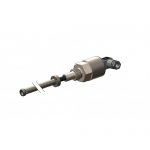
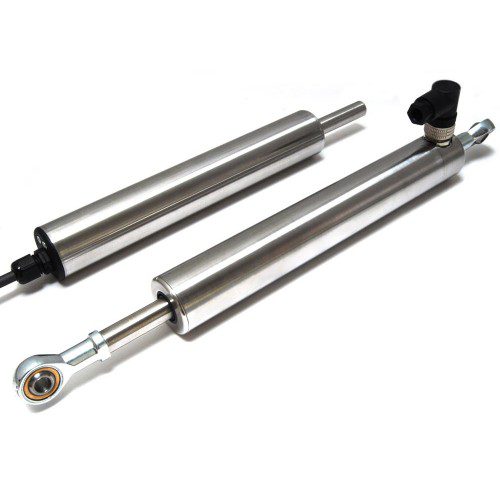
The intrinsically safe G111 is CSA approved for use in potentially explosive gas/vapour atmospheres. This heavy-duty version of the G101 sensor with a stronger 12.6mm push rod, recommended for applications where vibration is an issue or there is a need for longer travel sensors, mounted horizontally, and supported between rod eyes. It remains an affordable, durable, high-accuracy position sensor designed for industrial and scientific feedback applications. The unit is highly compact and space-efficient, being responsive along almost its entire length. Like all Positek sensors, the G111 provides a linear output proportional to displacement. Each sensor is supplied with the output calibrated to the travel required by the customer, from 0-5mm to 0-800mm and with full EMC protection built in.

The sensor is very robust, the body and push rod being made of stainless steel for long service life and environmental resistance. Overall performance, repeatability and stability are outstanding over a wide temperature range. The sensor is easy to install with mounting options including M8 rod eye bearings and body clamps. The push rod can be supplied free or captive, with female M8 thread, an M8 rod eye, or dome end, Captive push rods can be sprung loaded, in either direction, on sensors up to 300mm of travel. Environmental sealing is to IP65 or IP67, depending on selected cable or connector options.

Positek intrinsically safe sensors are designed to be used with a galvanically isolated amplifier . Approved galvanic isolation amplifiers (G005) are available from Positek; there is a choice of 0.5-9.5V or 4-20mA transmission outputs.

The sensor can be installed with a cable length up to 1km between the sensor and the amplifier.

Call us for more info at 856-727-9500

"*" indicates required fields
Hi, My name is

and I’m interested in the

You can reach me by email at

or phone at

Message

This field is for validation purposes and should be left unchanged.
You may also be interested in:

Positek

P118

  • Body Diameter: 19mm
  • Sensor Mounting: Flange or body clampsSpring loaded pushrod option available
  • Available in any measurement range from 0-2mm to 0-50mm(for 51-100mm range see P138)
  • Sealed to IP67

Positek

M130

  • ATEX/IECEx approved for mining
  • Sensor Mounting: In-cylinder
  • Available in any measurement range from 0-400mm to 0-1485mm
  • Sealed to IP65/67 depending on connector/cable option

Positek

Positek M500

  • ATEX approved for mining
  • 0.5-9.5V or 4-20mA outputs
  • ATEX variants of P502 & P505 available
  • Up to 160 deg range

Positek

X101

  • ATEX/IECEx approved to: Ex II 1G : Ex ia IIC T4 GA (Ta = -40°C to +80°C)
  • Sensor Mounting: M5 Rod Eyes, Body Clamps or M5 ThreadsSpring loaded pushrod option available
  • Any stroke from 0-5mm to 0-800mm (e.g. 305mm)
  • Sealed to IP65/67 depending on connector/cable option
Blog:

Facing the Inevitable: Sensor Obsolescence, Mitigation Strategies, and Alternatives

Obsolescence. If its only difficulty was remembering how it is spelled it wouldn’t be so bad. And whether you’re trying to replace a sensor that has failed with age or are a manufacturer who can no longer source an important sensor, obsolescence of an inexpensive sensor can create extremely expensive headache. At Everight Position we help customers to understand the causes of sensor obsolescence, explore mitigation strategies and find alternative solutions.

Trumeter Process Meter

There is a lot of talk about ‘data’ these days. But what can be just important as the data is how you communicate it.

Deciphering the Ideal Shafted Encoder: Beyond Optical vs. Magnetic

Welcome to a journey through the evolution and application of rotary sensors, with a special focus on magnetic sensing technology as presented by Everight Position, an Advanced Sales Partner of POSITAL products.

Introduction to Intrinsically Safe Sensors

Intrinsically safe (IS) sensors are unable to produce a spark strong enough to cause ignition. Learn how this is accomplished and design considerations when using IS sensors.