Positek

G103

Part no.: G103

Key Features

• CSA approved to: Class I, Zone 0

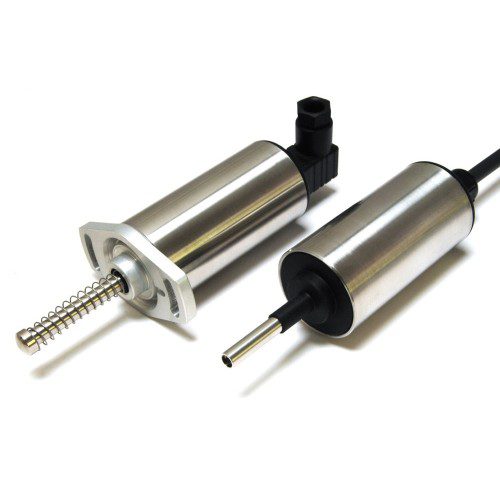
• Sensor Mounting: Flange or Body ClampsSpring loaded pushrod option available

• Available in any measurement range from  0-2mm to 0-50mm (for 51-100mm range see P133)

• Sealed to IP65/67 depending on connector/cable option

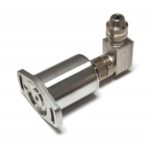
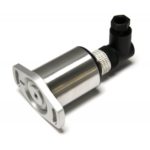
The intrinsically safe G103 is CSA approved for use in potentially explosive gas/vapour atmospheres. It is designed for a wide range of industrial applications and is ideal for OEMs seeking good sensor performance in situations where a short-bodied sensor is required for operation in hazardous areas. The unit is compact and space-efficient, being responsive along almost its entire length, and like all Positek sensors provides a linear output proportional to displacement. Each unit is supplied with the output calibrated to the travel required by the customer, from 0-2mm to 0-50mm and with full EMC protection built in.
Overall performance, repeatability and stability are outstanding over a wide temperature range.

The sensor has a rugged stainless steel body and plunger. It is easy to install and set up, mounting options include flange and body clamps. The plunger can be supplied free or captive, with female M4 thread, or spring-loaded with a ball end. The G103 also offers a wide range of mechanical options, environmental sealing is to IP65 or IP67 depending on selected cable or connector options.

Positek intrinsically safe sensors are designed to be used with a galvanically isolated amplifier . Approved galvanic isolation amplifiers (G005) are available from Positek; there is a choice of 0.5-9.5V or 4-20mA transmission outputs.

The sensor can be installed with a cable length up to 1km between the sensor and the amplifier.

Call us for more info at 856-727-9500

"*" indicates required fields
Hi, My name is

and I’m interested in the

You can reach me by email at

or phone at

Message

This field is for validation purposes and should be left unchanged.
You may also be interested in:

Positek

E115

  • ATEX/IECEx approved to: Ex II 1G : Ex ia IIC T4 GA (Ta = -40°C to +80°C)
  • Sensor Mounting: M8 rod eyes, body clamps or M8 threadsSpring loaded pushrod option available
  • Available in any measurement angle from 0-5mm to 0-800m
  • Sealed to IP68 10bar, 100msw, 145psi(for 350bar sealing see S125)

Positek

M603

  • Single axis
  • Up to 160°
  • Voltage or Current interface
  • IP67

Positek

X100

  • ATEX/IECEx approved to: Ex II 1G : Ex ia IIC T4 GA (Ta = -40°C to +80°C)
  • Sensor Mounting: In-Cylinder Mounting
  • Any stroke from 0-5mm to 0-800mm (e.g. 305mm)
  • IP65 (connector) / IP67 (cable)

Positek

G603

  • Single axis
  • Voltage or Current interface
  • IP67
Blog:

Liquid Level Sensor Interface

Enhancing Precision in Liquid Level Measurement with GS Liquid Level Software Introduction In the critical field of liquid level measurement, accuracy is a must, especially when monitoring parameters like emulsion layers and specific gravity. The GS Liquid Level software, designed to work seamlessly with Gill Liquid Level Sensors, is a revolutionary tool for engineers and […]

Seeing Is Believing: POSITAL 3D drawings now available for millions of encoders

POSITAL’s product finder has generated full specification custom datasheets for years. Rather than having to guess on specifications from a confusing product configurator, POSITAL provides part specific datasheets in real time for the given part number of interest.

Chips, Chips & Chips

What semiconductors, snacking and gambling all have in common: Encoders!

There has been a lot of talk lately around the global ‘chip’ shortage. Even social media last month was filled with cartoons of engineers asking Santa for semiconductors for Christmas. Rotary encoders such as the DS-130 by Netzer Precision are an important part of this ‘chip’ production. Accuracies exceeding 0.004 degrees, 21 bit resolution and a 90mm ID ensure that component placement can be done accurately and consistently.

Accuracy, Resolution and Repeatability

There are several key terms that are critical to specifying the optimal position sensor for a given application. This application note defines these key terms and how they relate to the sensor’s role in the overall system performance. It is important to consider that precision is very much a system issue and can be dominated by mechanical errors such as eccentricity. This paper discusses the most significant mechanical error for rotary applications (eccentricity) and presents eccentricity tolerant position sensor solutions.