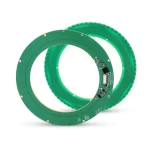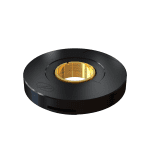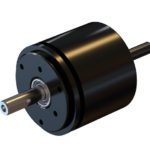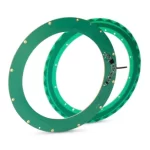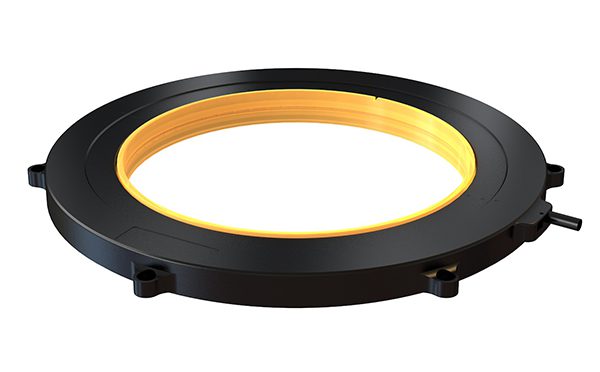
Part no.: Netzer DS-130
• 130 mm diameter
• SSI, BiSS-C
• Up to 21 bit resolution
• High tolerance to EMI, RFI and magnetic fields
The DS-130 is a member of the DS series of Electric Encoders a product line based on Netzer Precision Motion Sensor proprietary technology. Lightweight, compact and high performance (up to 21 bit resolution) these encoders provide unparalleled performance. The Electric Encoder is unique in being holistic, i.e., its output reading is the averaged outcome of the whole area of the rotor, This feature makes the Electric Encoder™ forgiving to mounting tolerances, mechanical wander etc. The absence of components such as ball bearings, flexible couplers, glass disc, light sources and detectors, along with very low power consumption makes the Electric Encoder virtually failure free. The internally shielded, DC operated Electric Encoder includes an electric field generator, a field receiver, a sinusoidal shaped dielectric rotor, and processing electronics. The output of Electric Encoder is a digital serial with absolute position single turn. The combination of precision, low profile, low weight and high reliability have made Netzer Precision encoders particularly suitable to a wide variety of industrial automation applications.
"*" indicates required fields

Netzer
Netzer
Netzer
Netzer
Spinal surgery robot with advanced robotic guided technologies supports high requirements of predictable surgical procedures.
Accuracy, Resolution and Repeatability
There are several key terms that are critical to specifying the optimal position sensor for a given application. This application note defines these key terms and how they relate to the sensor’s role in the overall system performance. It is important to consider that precision is very much a system issue and can be dominated by mechanical errors such as eccentricity. This paper discusses the most significant mechanical error for rotary applications (eccentricity) and presents eccentricity tolerant position sensor solutions.
Robonaut 2 (R2) is a state-of-the-art, highly dexterous anthropomorphic robot. The robot is designed to work with humans and has the ability to use the same workspace and tools.
The robot joints incorporate dual encoders for position and torque feedback while performing in a dynamic application, vibration, shocks, and wide temperature range.
Wiegand Effect Energy Harvesting
The “Wiegand effect” was discovered almost fifty years ago and has been used successfully in several specialized applications. However, its full potential for energy harvesting and signal generation has received only limited recognition. With recent enhancements to the energy output from Wiegand devices and the emergence of a new generation of ultra-efficient electronic chips for wireless communications, the technology is showing significant promise, especially in the exciting new area of the Internet of Things (IoT). UBITO, a member of the FRABA Group of technology companies, is leading research and development projects aimed at fulfilling this promise.