

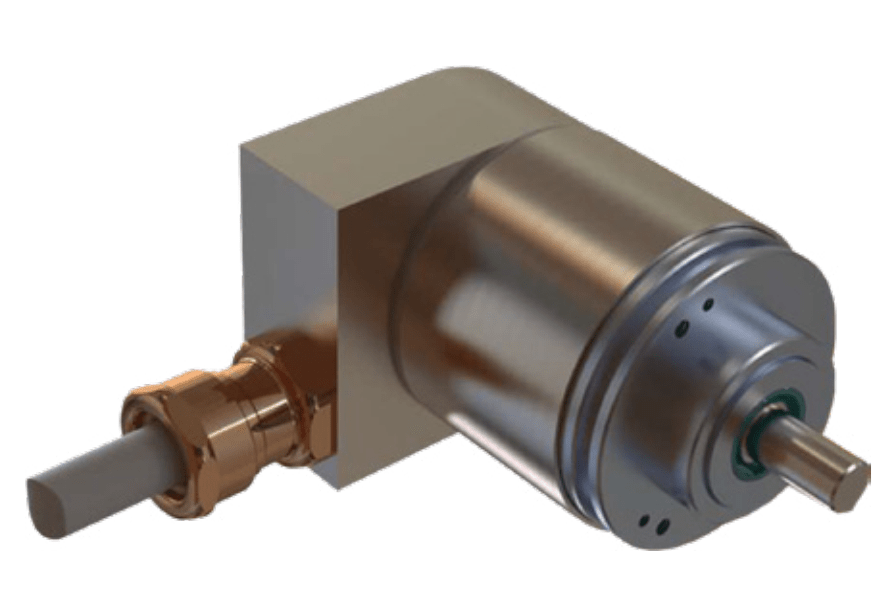


We specialize exclusively in high-performance rotary sensors.Whether it’s standard or a custom sensor our solutions help prevent costly errors or compromised safety.
For us, precision isn’t just a feature—it’s the foundation. We specialize exclusively in high-performance rotary sensors because accuracy and reliability are mission-critical in the industries we serve.
Whether it’s aerospace, automotive, medical devices, or advanced manufacturing, even the smallest deviation can lead to costly errors or compromised safety.
That’s why we engineer both standard and custom sensor solutions designed to withstand demanding conditions while delivering consistent, repeatable measurements.
When precision matters, Everight Position delivers.

Coveted for high-precision applications, these sensors rely on intricate light patterns to discern rotation, proving invaluable in scenarios where meticulous details matter most. Their application extends to industries where accuracy is non-negotiable.

These sensors leverage magnetic fields for detection and are particularly valued for their low cost, yet robustness in challenging environments. Recent advancements in TMR technology continue to close the performance gap with other technologies.

Utilizing the electrical property of capacitance to detect changes in rotary position, capacitive sensors are known for their lightweight, compact size, high accuracy and low power consumption. High immunity to EMI noise allows for close proximity to drives and brakes.

Inductive sensors operate on the same electromagnetic induction principle as a resolver but use PCB traces rather than coil windings. These sensors are very robust, as the rotor and stator can be potted in an epoxy-resin, offering protection against water, mud, dirt and other contaminants.
Navigating encoder options can feel overwhelming, but with some guidance, the task becomes manageable. By beginning with the mechanical aspects and progressively addressing the electronics and communication protocols, we can systematically narrow down the choices to find the perfect solution.
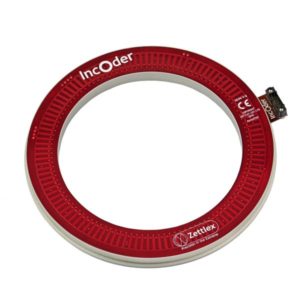
Zettlex IncOders are non-contact devices for precise angle measurement. They use an inductive technique, similar to that used by electrical transformers. IncOders are well suited to harsh environments-where potentiometers, optical or capacitive devices might be unreliable. IncOders have two main parts each shaped like a flat ring: a Stator and a Rotor. The Stator is powered and measures the angular position of the passive Rotor. A big bore and low axial height allows easy integration with through-shafts, slip-rings, direct drivemotors, optical-fibres, pipes or cables.
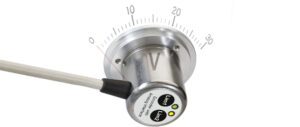
POSITAL UCD analog encoders are a novel alternative to traditional rotary encoders. Relying on a non-contact Hall sensor, UCD encoders are scalable by the end user, offer 13 bit resolution and multiturn counting.
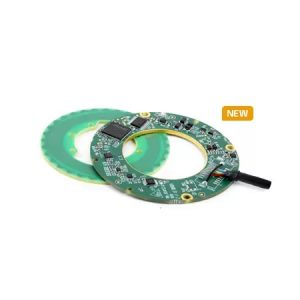
Netzer VLP encoders are ideal for OEM applications. Featuring an open frame, 2 plate design, the sensor is lightweight, highly tolerant to temperature, shock, EMI, RFI and magnetic fields. Iit offers a unique combination of high performance at an economical cost.
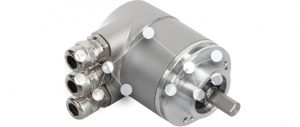
POSITAL encoders with CANopen and SAE J1939 interfaces support a wide variety of applications, from industrial automation to mobile machinery.

In these critical fields, our sensors are integral to mission success. They deliver exact measurements for flight control, satellite positioning, navigation, and weapon systems. Durability and precision define our rotational position sensors and rotary shaft encoders, ensuring reliability under the demanding conditions of defense and aerospace operations.

Our sensors streamline production and improve operational efficiency in manufacturing. They are crucial for precision tasks such as assembly line automation, conveyor speed control, and CNC machine alignment. Supporting Industry 4.0 initiatives, they enable smarter, interconnected manufacturing processes where precision and speed are key.

In robotics, our sensors enhance the precision and efficiency of industrial applications, including material handling and welding. In the burgeoning field of surgical robotics, they provide the control and accuracy necessary for delicate medical procedures, directly impacting patient outcomes. These applications underscore the role of our sensors in advancing both industrial and medical robotic technologies.
60% of our projects involve customizing existing encoders to meet specific client requirements. This extensive experience allows us to offer solutions that are not only technically sound but also cost-effective and timely.
"*" indicates required fields